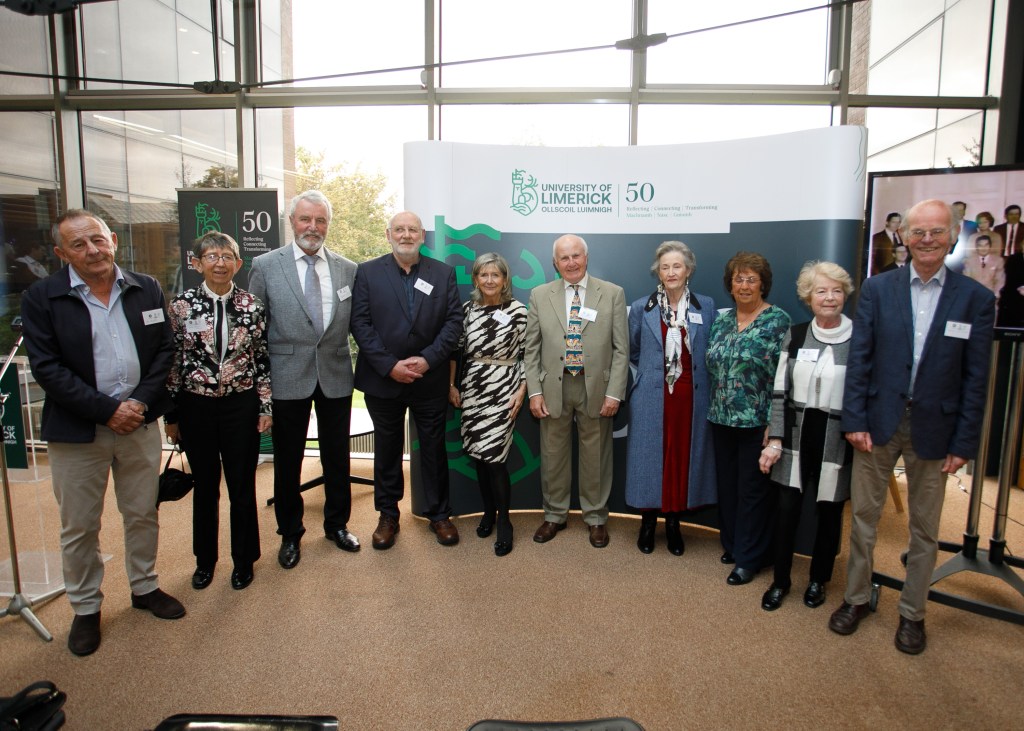
Members of the LSUPC committee: Jim McGann, Jane Doyle, Kieran Daly, Niall Connery (Widower, Mary Earls), Clare Doyle, Gerry O’Malley, Cathleen Treacy, Mary Bradshaw, Cliona Keogh, Brian Callanan (UL50 Reception for LUPC and LSUPC committees)
As today is International Students’ Day (17 November 2026) I thought I would look at a group of students that are often forgotten about when looking at the campaign for a university for Limerick city in the 1960s: The Limerick Students’ University Committee (LSUC) I was fortunate enough to interview some of the students who were active in that campaign, Jerry O’Malley, Mary Bradshaw and Jim McGann as part of the UL Oral History Project in 2022.
By the early 1960s secondary school students in Limerick had grown despondent that if they wanted to attend university very often they could not because of the cost associated with attending college in Dublin, Cork, or Galway. A debate held at the Crescent Comprehensive School before Easter 1966 on the pros and cons of a university for the city was the starting point of a campaign by the secondary students of Limerick to be given a fair opportunity at a third level education. The LUSC worked in tandem with the Limerick University Project Committee (LUPC) that had been established in 1959 to demand that the Irish government establish a university in Limerick. The first chairperson of the LUSC was Gerry O’Malley, nephew of Donagh O’Malley.
At the time the idea of students stepping outside of the boundaries assigned to them and challenging authority was seen by many as anathema. In Ireland young people did not challenge authority figures and accepted what they were told to do. Due in large part to the professional way the LSUC was run they did receive enough support from the public and in particular school principals. The first major demonstration came in April 1966 when 320 students travelled to Dublin to meet the then Minister for Education George Colley. However, Mary vividly remembers that there was opposition to the students protesting in Dublin. It is worth remembering that the first student protest was held as Ireland was getting ready to mark the fiftieth anniversary of the 1916 Rising. For a time Mary had to leave Limerick to stay with relatives in Dublin. That however, worked to the committee’s advantage as she was able to organise the march in Dublin. A second march in the city was described by Tom Tobin editor of the Limerick Leader under the pseudonym ‘Vigilans’ as a ‘half-hearted parade through the city’ and stated that it was time that the students stopped ‘their search for self-glorification and went back to their studies’. While students wanted to protest outside the Limerick Leader offices a decision was taken not to in case it provoked a public backlash within the city. One of the most remarkable feature of the students demand for a university was the continuity of the committee: as students left school new members willing joined the campaign. When Gerry O’Malley went to study at UCC in the Autumn of 1996 he was replaced by Jim McGann as chairperson. Jim recalls that by the summer of 1968 anger and frustration had set in amongst the students. A more confrontational approach was taken including the burning of an effigy of the then Minister for Education Brian Lenihan. The largest student demonstration occurred on 2 October 1968 at Beford Row. It was supported by Dr Hilda O’Malley, widow of Donagh O’Malley, and actor Richard Harris. Jim recalls that as they protested on O’Connell Street, the Gardai were determined to get them of the streets by force if necessary. At the end of 1968 Brian Lenihan announced that limerick would be getting ‘something better than [a] university’. In 1972, NIHE was officially opened at Plassey and in 1989 the College was officially given university status. The first university created in Ireland since the creation of the Irish Free State in 1922.
We used these megaphones to keep the march kind of going up along the quays and up to O’Connell Street [Dublin]. Of course, then we stopped at the Four Courts, that was the office of the Commission of Higher Education, and we had a pre-arranged meeting organised with the secretary of the Commission of Higher Education who did not feel very comfortable and did not want to be meeting us … and I can assure you of that but, they [fellow students] used the megaphones very effectively outside of the Four Courts and when we came out and when were finished there, we moved on then to Marlborough Street, where Tom O’Donnell, TD, Stephen Coughlan, TD, and Donogh O’Malley, TD, minister for health, accompanied us into the meeting with George Colley … the Minister for Education and it was the members of the committee that actually went in on the deputation and George Colley was very uncomfortable’
(Gerry O’Malley, LSUPC Member, 25 February 2022)
While we were in with the minister, George Colley, Kieran Daly made a passionate speech, which was unbelievable as he had all his research done. In the middle of it all our group were down below protesting and the megaphones were going and George Colley said ‘Is that yere riff raff down there’ and I remember saying excuse me, they are our colleagues, and they feel as strongly about a university in Limerick as we do and a lot of them would be deprived from going to third-level, but I was fuming I have never forgotten the anger inside of me, ‘that riff raff’ that is how he described us.
(Mary Bradshaw, LSUPC Member, 25 February 2022)
… I definitely think we got more radical … [In October 1968], I remember we had organized quite a big student demonstration and we were outside around Cruises [Hotel] and William Street and O’Connell Street I suppose around that sort of Todd’s [Brown Thomas] there and you know shouting away. There was a lot of guards around I never had much to do with them, and they were not nice in those days to have anything to do with it. But I remember there was this big sergeant guy … and he was standing with his hands behind his back like the guards always did in Ireland in those days. And he talked out the side of his mouth, he said…I can’t say what he said because you won’t be able to put it in. But he said if you don’t get out of here I’ll break your…And I said, but you can’t, we have the right to demonstrate and what have you. ‘You have to keep moving’ he said or something to that effect I said yeah that’s no problem. We go up William Street in Little Catherine Street around the block and come back again …. Students and demonstrating in those days was not accepted. It wasn’t accepted in Limerick whatever they all say you know.
(Jim McGann, LSUPC Member, 14 March 2022)
Dromcollogher Cinema Fire 1926

The final resting place for the victims of the fire
On 5 September 1926 a cinema exhibition was held in the town of Dromcollogher County Limerick. The exhibition was held above a storeroom and lacked even the most basic of fire safety measures. Less than a hour into the show a fire broke out. In the ensuing panic forty-eight people died. It remains one of the worse disasters to occur in Ireland equalled only by the Star Dust fire of Valentine’s night 1981 in which forty-eight people also died.

Dromcollogher County Library site of the cinema fire
Thanks to funding from the Royal Irish Academy, I have been carrying out research on the event in the led-up to centenary of the fire. Using oral history testimonies from the descendants of those that died as well as other archival material, I am seeking to understand how the fire was remembered and memorialised over the last century. I am currently completely a book on this truly terrible tragedy to mark the centenary of the cinema fire. A link to a talk I give to the American Irish Historical Society on the fire can be found here https://www.youtube.com/watch?v=e5dbVws3VIw&t=26s

The University of Limerick Oral History Project
Since 2021 I have been working part-time as the Project Officer for the Oral History Project at the University of Limerick. For me, as an alumni of the University, it has been a privilege to record the memories of those who have work and studied at NIHE/UL & NCPE/Thomond College over the last fifty-years. Just over forty-five interviews are housed on the University of Limerick Digital Library web page. A link to the Project can be found herehttps://digitallibrary.ul.ie/university-limerick-oral-history-project-ulohp?search=oral%20history
Two of the key success of the project are the publication of ‘University of Limerick an oral history, 1972 – 2022 and an exhibition run in conjunction with the Women’s History Association of Ireland in 2022 called ‘Fifty years of ‘Pioneering Women’ at the University of Limerick: Past and Present’ . In 2023 I had the opportunity to present my work at the Royal Irish Academy ‘HER-ald: HER archives, literature, documents, Mná 100 Conference. a link to the talk can be found here https://www.youtube.com/watch?v=Xc032rfKFb8
Friendships Highway: Migration and Irish Girls’ Friendly Society Members, 1885 – 1935

The Girls’ Friendly Society, established in Ireland in 1887 – two years after the English GFS had been formed, sought to look after the moral welfare of young, Protestant women. Its work included the running of lodging homes , sick and convalescent homes, clubs and so on. One of its main functions was the protection of women as they migrated from Ireland. Ledgers were kept that detail each part the women’s journey. At ports and railway stations they were meet by an associate member who looked after them thus ensuring their moral safety.
Using information from two ledgers I identified just over 700 women who were helped by the GFS and created a database (1885 – 1935) that provides a rich stream of information on this often overlooked group of women. In 2024 I was awarded a place on a pilot scheme devised and run by the Digital Repository of Ireland that allowed me to develop a fully searchable database using these two key resources. A link can be found here and his free for anyone to use https://repository.dri.ie/catalog/hh646r35d

